THE CEILING OF CONVERGENCE: MECHANIZED THEORYCRAFTING IN REMNANT 2
THE CEILING OF CONVERGENCE: MECHANIZED THEORYCRAFTING IN REMNANT 2
The central engineering triumph of Remnant 2 is its procedural generation engine, which rearranges entire storylines, side dungeons, and boss encounters across completely unique instances. This unpredictability creates an exquisite sense of organic exploration during the early hours of character progression. Yet, as players transition from simple narrative completion to high-level optimization, the game shifts from a fluid, adaptive adventure into a calculated spreadsheet simulation governed by unforgiving mathematical barriers.
The specific structural conflict arises from a fundamental design pivot away from its predecessor, Remnant: From the Ashes. In the original game, players could infinitely farm and upgrade every single passive passive trait, eventually transforming their survivor into a multi-faceted deity. In Remnant 2, Gunfire Games introduced a strict, unyielding cap on total assignable Trait Points. This design choice was intended to create meaningful friction and force distinct, specialized choices, but its interaction with high-tier enemy damage profiles has instead triggered a systemic bottleneck.
The Hard Limit: Shifting from Infinite to Restricted Growth
The temporal journey of a Remnant 2 character begins with an open canvas of potential, where every found Trait Point represents a palpable surge in survival capacity or mechanical utility. Early game progression feels incredibly rewarding because players can freely allocate points into fun, utility-focused passive skills like increased movement speed, wider area-of-effect radii, or faster weapon swapping. The mechanical friction is virtually invisible during these initial hours because the baseline enemy attributes do not yet demand mathematical perfection.
However, the moment a character collects their maximum allotted Trait Points, the psychological nature of build progression fundamentally alters. Progression hits an immediate, absolute wall. Instead of looking forward to the next dungeon run for incremental self-improvement, the player is trapped inside a closed zero-sum ecosystem. To enhance a single defensive capability, they must manually siphon resources away from another active utility, changing the game's core loop from an additive reward system to a subtractive compromise.
Apocalypse Difficulty and the Mandatory Defense Monopoly
As a character steps onto the highest difficulty tier—Apocalypse mode—the underlying scaling math of Remnant 2 aggressively exposes the illusion of choice within its restricted trait ecosystem. On this setting, enemy damage modifiers scale exponentially, turning standard boss encounters into brutal, single-mistake elimination trials. To avoid being instantly killed by basic physical strikes, characters must reach highly specific thresholds of effective health pool calculations.
This extreme environmental pressure turns a handful of survival-oriented passive skills into non-negotiable structural anchors for every single functional build. Traits that directly mitigate incoming damage or amplify base health pools cease to be optional preferences and become mandatory requirements. Consequently, a massive chunk of the hard-capped Trait Points must be universally dedicated to the exact same defensive nodes, leaving a pitifully small remaining pool for players to express their mechanical individuality.
The Non-Negotiable Defensive Foundation
- Fortify: Increases armor effectiveness up to 50%, providing the raw mechanical buffer necessary to survive sweeping physical strikes.
- Vigor: Grants a flat increase to maximum health, serving as the essential foundation for all incoming damage calculation scaling.
- Regrowth: Provides steady health regeneration, reducing structural reliance on finite relic charges during multi-phased attrition boss fights.
The Extinction of Quality-of-Life Traits
Because the mandatory survival attributes consume the lion's share of the rigid point allocation pool, utility-focused passive nodes suffer a total systemic extinction in high-level play. Remnant 2 features an array of incredibly creative, flavor-rich traits designed to modify the tactile feel of gunplay and movement. Concepts like extending the slide distance, accelerating weapon stowing speeds, or increasing item pickup radii are genuinely transformative additions to moment-to-moment gameplay.
Unfortunately, under the current mathematical regime, spending precious, capped points on these utility options is an objective form of mechanical self-sabotage on high difficulties. If a player allocates points to maximize their footwork speed or weapon handling fluidity, they are directly giving up the raw defensive percentages required to survive an unblockable shockwave. This reality creates an agonizing structural divide where the "coolest" ways to customize a survivor's kinetic movement are actively penalized by the unforgiving damage math of the endgame.
Dual-Archetype Synergy and the Illusion of Class Freedom
To offset the limitations of the hard trait cap, Gunfire Games engineered a magnificent dual-archetype system, allowing players to slot a primary and secondary class to combine unique perks, active skills, and automated archetype traits. On paper, mixing a long-range Hunter with a mystical Archon creates a distinct tactical identity. In practice, however, the absolute power of certain universal archetype traits forces a predictable gravity on class selection.
The issue lies in how specific archetype perks interact with the universal trait ceiling. Certain classes automatically unlock max-tier utility values for free simply by being slotted into the character profile. For example, the Challenger archetype naturally maximizes armor effectiveness, while the Medic drastically amplifies healing outputs. Because these slots grant maximum point value without tapping into the player's finite manual pool, certain archetype pairings become overwhelmingly efficient "stat sticks" used primarily to balance character sheets rather than explore genuine playstyle variations.
Damage Scaling Math and the Tyranny of Multipliers
The optimization bottleneck in Remnant 2 is further complicated by how the internal combat engine calculates offensive output. The game distinguishes between additive stat increases and multiplicative damage sources. To break through the massive health bars of high-tier enemies, theorycrafters must carefully layer their chosen rings, amulets, and weapon mutators to trigger multiplicative cascades.
The Anatomy of an Optimal Damage Cascade
Phase 1: Status Affliction Trigger
Applying a persistent elemental status effect, such as burning or corroded, to instantly activate localized ring multipliers that target debuffed entities.
Phase 2: Ranged Multiplier Stacking
Activating temporary weapon mods or archetype skills that multiply base ranged damage output rather than adding simple flat percentages.
Phase 3: Critical/Weakspot Convergence
Exploiting precise weakspot hitboxes during tight windows to force overlapping multiplicative damage spikes that bypass baseline enemy defenses.
This intricate dependency on perfect synergy creates a massive gap between optimized setups and experimental builds. If a player tries to build a highly versatile character that mixes mid-tier elemental damage with casual melee utility, the underlying math punishes them severely. Without fully committing to a single, hyper-focused multiplicative damage vector, an experimental build's time-to-kill metrics plummet, turning endgame boss encounters into exhausting, error-prone marathons.
Weapon Mod and Mutator Bottlenecks
Because the universal trait system cannot provide meaningful offensive specialization due to the point cap, the entire burden of build definition shifts onto weapon mods and mutators. Weapon mods allow guns to fire explosive projectiles, summon automated turrets, or manifest temporal slow-motion fields. Mutators act as slotable gems that add unique passive conditions to individual firearms.
However, because certain mutators provide raw, universal damage multipliers with zero operational downsides, they quickly centralize the endgame meta. Mutators that amplify damage based on remaining magazine capacity or critical hit chance are so mathematically superior to utility-oriented options—like faster reload speeds on empty chambers—that they render a vast majority of the loot pool obsolete for high-tier content. The weapon customization tier suffers from the exact same homogenization as the trait system, reducing a vast collection of unique artifacts to a handful of optimal choices.
Dominant Endgame Mutators:
- Momentum: Grants stacking critical hit chance and critical damage upon landing successive strikes, completely dominating high-rate-of-fire weapons.
- Twisting Wounds: Applies an automatic bleeding status effect on critical hits while multiplying ranged damage against bleeding targets.
- Battery: Amplifies the next mod activation damage based on spent ammunition, creating an essential loop for mod-centric spellcaster builds.
Relic Fragments and Statistical Micro-Management
The final layer of character tuning comes from Relic Fragments—small, color-coded gems inserted into the player's healing relic to provide minute percentage increases to specific attributes like casting speed, armor tier, or melee attack velocity. While this system looks like a highly granular endgame customization matrix, it uncovers a tedious micro-management hurdle that adds zero narrative or structural satisfaction.
The specific issue is that Relic Fragments are gated behind a multi-tiered upgrade system tied directly to the player's total Archetype Level and world difficulty setting. To acquire the highest tier of fragments, players must continuously gamble their raw materials at a town merchant while switching world settings. This turning of an item into an incremental slot machine turns the final step of build refinement into a repetitive administrative chore, further distancing the player from the visceral action of the world.
The Co-Op Scaling Friction
The systemic rigidity of Remnant 2’s scaling math becomes uniquely apparent when transitioning from solo play into multi-player cooperative sessions. When multiple survivors team up, the game engine automatically scales up enemy health pools and incoming damage output to compensate for the presence of extra guns. While logical in theory, this scaling formula introduces intense mechanical friction for non-optimized cooperative teams.
If one member of a three-person team is running a creative, non-optimized utility build that lacks maximum defensive mitigation, they become an immediate liability. Enemy attacks that would normally leave them with a sliver of health in solo play become definitive, one-hit squad wipes in co-op. This reality places immense social and mechanical pressure on group members to abandon experimental playstyles and adopt the uniform, hyper-optimized defensive metas simply to avoid dragging down the entire squad's progress.
Narrative Dissonance: The God of Math in a Dying Universe
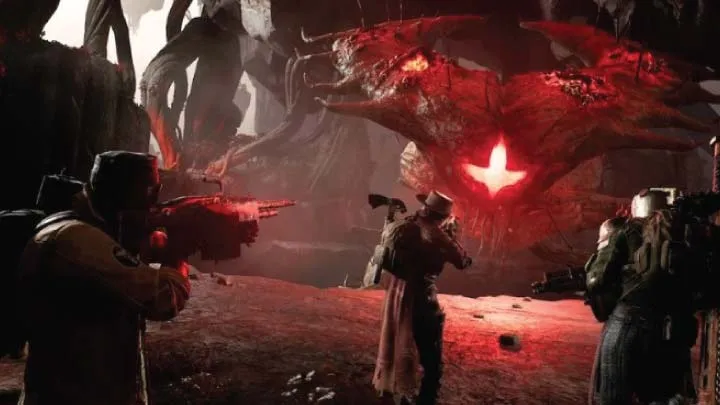
There is a profound aesthetic and narrative dissonance woven tightly into the fabric of the Remnant 2 experience. The sweeping lore paints a picture of a desperate, cosmic struggle against the Root—a reality-consuming corruption threatening to erase existence itself. The environments are masterfully realized, shifting from the gothic, rain-slicked streets of Losomn to the desolate, sci-fi vacuum of N'Erud, as beautifully evoked by the cosmic scale of the artwork in image 17.jpg.
Yet, this dark, evocative fantasy is frequently broken by the sterile corporate calculations demanded by the game's strict mechanical ceiling. Instead of feeling like a desperate, battle-hardened survivor adapting to alien horrors on pure instinct, a player at the endgame behaves more like a financial accountant. The terror of a multi-dimensional apocalypse is entirely minimized when the main threat is not the design of the monster, but whether a character sheet possesses a 73% or 80% damage reduction calculation.
Conclusion: Loosening the Reins of Theorycrafting
In conclusion, Remnant 2 is an undeniable masterpiece of systemic design, offering one of the most thrilling, atmospheric, and replayable action-RPG experiences of the modern gaming era. Its kinetic combat, jaw-dropping art direction, and ingenious procedural generation engine set a bold new standard for the industry. Yet, the specific issue of its absolute Trait Cap and rigid multiplier math represents a profound structural anchor that continuously fights against the game's core philosophy of endless discovery.
By trapping the endgame player within a zero-sum trait economy, the system inadvertently funnels the most dedicated segment of the community into a highly homogenized pool of optimal builds. To truly unleash the staggering creative potential of its dual-archetype architecture, the framework must find a way to let players invest in horizontal utility without explicitly sacrificing vertical survivability. Until the strict boundaries of the passive progression metrics are loosened, the path through the changing worlds of Gaia and beyond will remain a journey that is brilliantly designed in its soul, but occasionally trapped inside the cold, unyielding cage of its own math.